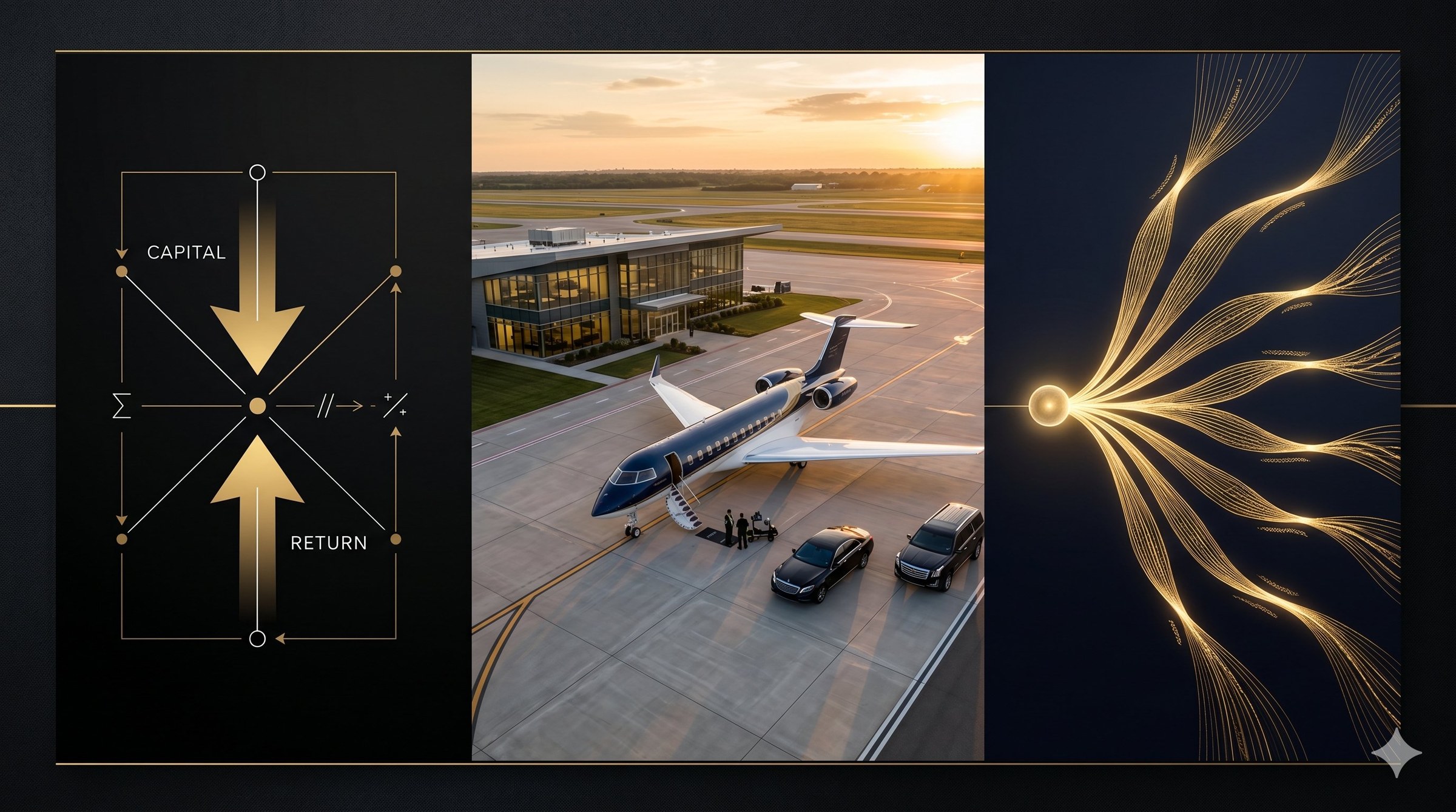
"ROIC = Net Operating Profit ÷ Invested Capital. Reduce the denominator while sustaining the numerator — and returns compound."
Every structural decision in the Global Lifestyle OS — aviation, real estate, education, mobility, services — is designed so invested assets retain independent value, the fixed cost base remains minimal, and revenue is diversified across multiple non-correlated layers.
Most investment models follow a familiar pattern: acquire or build the asset, operate it, and hope the market moves in your direction. When the asset underperforms, capital is trapped. When strategy changes, the asset cannot easily be redeployed. The Global Lifestyle OS was designed with the opposite structure.
"The world's most capital-efficient businesses — Marriott, Airbnb, Hyatt — proved the principle: the highest returns come not from owning more assets, but from controlling the network that others' assets operate within."
Global Lifestyle OS · Capital Efficiency Analysis · 2026
The Global Lifestyle OS is built on six structural principles — each one designed to minimise committed capital while maximising the independent value of every invested asset. Together, they create a compounding advantage that conventional asset-heavy models cannot replicate.
The conventional approach to premium aviation is capital-intensive by design: own the fleet, staff the crews, operate the FBOs. GLO takes the structure used by the world's most sophisticated aviation clients — who have already concluded that no capital should be tied up in aviation assets when the service can be accessed without ownership.
3,500+ FBOs exist globally. GLO does not rebuild what already exists. Capital is deployed only where it creates disproportionate, durable value across all 8 service layers simultaneously.
| Model | When Applied | Capital Efficiency |
|---|---|---|
| Direct Build / Acquire | Core hubs where all 8 service layers generate maximum revenue. Full ownership justified by diversified income stream. | Physical asset acquired at cost. Real estate value appreciates independently. Partial sale always available. Non-aviation revenue target: 60%+. |
| Strategic Partnership | Secondary hubs where service consistency matters but full ownership is not justified. | GLO platform + AI operations deployed to existing FBO. Zero acquisition premium. Zero construction. Variable cost only. |
| Partner Network | All other locations in the active service geography. | Local FBO operators qualified to GLO standard. Zero capital deployment. Full geographic coverage activated immediately. |
The 60%+ non-aviation revenue target is structural protection, not aspiration. A conventional FBO lives and dies with flight demand. The GLO FBO Hub generates revenue from membership, medical, education, logistics, hospitality, and security — independent of whether an aircraft is on the ramp.
Acquiring a US elite private school is not a viable strategy — not because of lack of ambition, but because the asset itself resists acquisition. Lower-tier private schools start at $100M+. Elite schools hold endowments of $100M–$900M and carry institutional value that is incalculable. Acquisition is structurally near-impossible. GLO does not need to acquire. The 26-year network is the asset.
Where deeper integration creates disproportionate revenue, a Special Purpose Corporation (SPC) is established — a jointly-owned entity for exclusive GLO service delivery. Crucially, the SPC uses staged capital deployment: investment is linked to revenue milestones, not committed upfront. The largest outlays occur only when the revenue to justify them is already visible.
New mobility technology is a genuine opportunity — and a genuine risk. Capital follows safety certification, not ambition. This is not conservative. It is the highest form of capital efficiency: capturing the revenue opportunity without absorbing the development and safety risk.
Every service layer beyond aviation and FBO Hub — residential preparation, companion logistics, medical response, food provisioning, security — is delivered through curated local specialists. GLO qualifies, coordinates, and quality-controls. GLO does not employ.
GLO logistics is not conventional cargo transport. It is a life-companion service layered on top of already-built private jet, FBO, AEV, and AI infrastructure — with no additional large-scale investment required. The infrastructure is already there. The logistics revenue is created on top of it.
The core of GLO Companion Logistics is not a separately-built logistics system. It is an AI prediction layer combined with already-operating private jet infrastructure and an FBO Hub and AEV network that are advancing through active build-out. Existing asset revenue expands — without additional infrastructure investment.
| Layer | How It Works | Capital Efficiency |
|---|---|---|
| Layer 1 · AI Pre-Sensing (48–72h advance) | AI analyses member schedule, movement patterns, and historical data to automatically predict and pre-arrange required items, services, and companion cargo 48–72 hours before arrival. | No separate logistics staff required. AI processes automatically using existing data infrastructure — zero marginal cost. |
| Layer 2 · Hub Stock (Pre-positioned inventory) | Member-customised items pre-stocked at each FBO Hub before arrival. Companion animal essentials, lifestyle provisions, and cargo-related supplies ready on arrival. | FBO Hub existing facilities utilised. No additional warehouse required. Inventory included in member subscription. |
| Layer 3 · Instant Delivery (Drone · AEV · eVTOL) | Any items needed immediately post-arrival delivered via the AEV, drone, and eVTOL network as each is built out. Zero additional fleet investment once live. | AEV is operating today; eVTOL and drone delivery are roadmap. Adding logistics to each = near-zero marginal cost per delivery once the mobility layer is live. |
| Existing Asset | Additional Logistics Utilisation | Additional Capital Required |
|---|---|---|
| Private jet (already flying) | Companion animals, artwork, confidential cargo, fashion collections — in cabin with owner | Zero — already flying aircraft |
| FBO Hub (existing facilities) | AI pre-stocking hub / companion cargo preparation / customs processing point | Minimal — additional use of existing space |
| AEV fleet (operating today) | Immediate post-arrival delivery / high-value secure cargo transport | Zero — cargo added to vehicles already in service |
| AI operating system (existing) | 48–72h pre-sensing / customs automation / real-time cargo monitoring | Zero — logistics layer on existing AI |
| Member relationship (existing) | Preference-data-driven automatic service / additional subscription options | Zero — extension of existing member data |
The GLO Logistics Capital Efficiency Formula: Existing infrastructure (private jet + FBO + AEV + AI) × logistics layer addition = additional revenue, no additional large-scale investment. This is the core synergy of the 8-layer model — each layer generates independent revenue while simultaneously lowering the cost and raising the value of every other layer. The platform becomes more efficient, and more valuable, with every service layer added.
Every industry has its own capital consumption pattern. Comparing structures reveals why the GLO investment profile is not merely better — it is structurally distinct.
| Category | Game Development Industry | Semiconductor Industry | Global Lifestyle OS |
|---|---|---|---|
| Pre-Revenue Capital | Years of development with zero revenue. Hundreds of millions invested before any market validation. Cost accumulates entirely before any return. | Fabrication facilities: $5B–$20B+. Zero production before the facility is fully operational. Equipment lead times: 1–2 years. | Revenue from Day 1 via existing operations. Each service layer added sequentially. No large pre-revenue capital commitment required. |
| Cost Predictability | Technical failures, talent attrition, market shifts can multiply budgets before launch. No reliable forecast possible at project outset. | Equipment procurement and yield improvement frequently cause 2–5× initial budget overruns. Routine in early process nodes. | Every investment phase has a market-verifiable cost basis — aircraft prices, real estate appraisals, partnership terms. Transparent and auditable at every stage. |
| Worst-Case Exit | Failure = near-total loss of development capital. Creative assets (code, art, content) have near-zero secondary market value. No exit available. | Specialised manufacturing equipment has severely limited secondary value. Purpose-built facilities are not general-purpose assets. | Aircraft → active secondary market sale. FBO real estate → general property market. Partnership agreements → contract termination. Selective partial exit available at any point. |
| Revenue Commencement | Only after successful launch. Binary outcome — full investment at risk throughout. Industry average success rate: 20–30%. | Only after volume production at acceptable yield. Break-even typically 3–5 years post-launch. | From Day 1. Each new service layer adds an independent revenue stream as it is activated. Investment growth and revenue growth move together. |
| Scaling Model | Each new product requires full development cost again — from zero. Success does not compound capital efficiency. | New facility = $5B–$20B again. Every expansion is another major capital commitment. | New city = partner qualification + platform activation. Marginal cost declines as the network scales — network effect compounds. |
| Revenue per Client | Mass-market: ARPU typically $5–$70 per user. Volume-dependent model. | B2B supply contracts. No direct high-value consumer relationship. | Private jet charter: $20,000–$150,000+ per flight. Annual membership: multi-hundred thousand dollars. 8-layer combined = one member's annual value exceeds thousands of mass-market customers. |
Capital efficiency analysis reaches a single conclusion: GLO begins with minimum capital and generates revenue at maximum unit value. The combination of these two properties defines an ultra-high-value business structure — one where a small membership base is sufficient to build a highly profitable operation.
A private jet member subscribes to education, uses the FBO, adds medical and logistics. One member becomes multiple simultaneous revenue streams. The platform gets more valuable with each service added.
Every investment is anchored to market-verified assets. Aircraft prices, real estate appraisals, partnership terms — all independently verifiable and auditable at any point. No hidden cost accumulation.
Aircraft, real estate, and partnership agreements all carry independent market value and independent exit mechanisms. Partial divestment — in any combination, at any time — is always available.
A small membership base is sufficient to build a highly profitable business. We compete on value, not volume. The revenue per dollar of invested capital is structurally superior at every scale.
| Investment Category | Conventional Asset-Heavy Model | Global Lifestyle OS |
|---|---|---|
| Initial Capital Required | Large upfront: full acquisition or construction committed before first revenue | Staged: partner-first, selective ownership where revenue justifies. Day 1 revenue from existing operations. |
| Downside if Strategy Shifts | Capital trapped in illiquid asset — sale requires specialist buyer at discount to book value | Aircraft: independent market value. Real estate: independent market value. Education SPC: milestone-linked, terminable. eVTOL: return to operator. |
| Fixed Cost Structure | High fixed overhead: staff, maintenance, facilities — regardless of revenue performance | Minimal fixed cost: platform + core team. Variable cost activates with revenue. Scales in both directions. |
| Revenue Diversification | Single sector — fully exposed to that sector's cyclical risks | 8 service layers × multiple hub cities. 60%+ non-aviation revenue target. No single point of failure. |
| Competitive Barrier | Capital can replicate most assets — build a similar facility, hire similar staff | The 26-year education network cannot be purchased. Platform network effects deepen with every member added. |
| Return Profile | Binary in some sectors. Cyclical in others. Full capital at risk throughout. | Recurring membership + 8 service layers. Non-cyclical. Each new member compounds the revenue base. |
| Exit Options | Illiquid in most scenarios. Requires strategic buyer who values the exact same asset. | Multiple independent exits at any point: aircraft sale, RE sale, partnership termination. No single lockup. |
Lower invested capital → higher ROIC → more capital available for the next phase.
Variable cost structure → resilience in downturns → no forced asset sales at distressed prices.
Independent asset liquidity at every level → no capital lockup, no single-point-of-failure exposure.
Staged capital deployment → investment tied to proven revenue → no speculative large commitments.
26-year network as core asset → irreplicable competitive barrier → premium pricing that compounds.
8-layer diversified revenue → non-cyclical income base → stable platform for further investment.
What a strategic partner gains in this structure: physical assets that retain independent market value · recurring, diversified revenue across 8 service layers · the 26-year education network — the only asset that cannot be replicated with capital alone · a first-mover position in the market every sector leader is currently missing · platform network effects that compound with every member added · staged capital deployment — the largest commitments occur only when revenue justifies them.
Minimum risk. Maximum value. Eight revenue layers. One platform — built for the most valuable client in every sector simultaneously.