Global Lifestyle OS announces the foundational framework for a location-independent international school — developed through direct partnership dialogue with multiple US elite private schools, and agreed across every dimension of establishment, accreditation, curriculum, and governance.
On partner school disclosure: The identities of US elite private school partners are not disclosed pending legal finalization — anticipated H1 2027. Every element of this framework reflects substantive agreements reached through direct engagement — not proposals, not aspirations.
Every international school of standing is built around a campus. The campus is the product. When a globally mobile family relocates — for business, lifestyle, or opportunity — the education stops. The child transfers. The curriculum changes. The peer network dissolves. The university admissions pathway resets.
For UHNWI families and Fortune 1000 executives, this is not a minor inconvenience. It is the single most cited reason executives decline overseas postings, and the primary cause of international assignment failure — at a cost of three to four times annual salary per failed posting.
No international school group in the world has solved this. Nord Anglia, GEMS, Inspired Education — all campus-dependent by architecture. The Finest School framework was designed from its foundation to eliminate this structural failure: not by building a better campus, but by building a school that travels with the student.
The framework accommodates three distinct establishment structures. The final model is selected jointly by Global Lifestyle OS and the lead US partner school, based on optimal conditions at the time of execution.
The academic standing of students enrolled through The Finest School is equivalent to attending the US partner school in person — regardless of physical location.
Accreditation obtained through the relevant US state authority and regional body (WASC, NEASC, AdvancED, or equivalent) of the lead partner school. The new institution carries the same accreditation standing as the US parent school from day one.
Each regional campus and education centre is established in full compliance with the national law of the host country — while maintaining the academic identity, curriculum standards, and institutional character of the US partner school. Not a compromise. A dual-compliance architecture designed into the framework from the start.
The education does not stop when the family moves. The four delivery modes operate independently or in any combination — selected by the student and family according to location, schedule, and circumstance.
Every element of the curriculum is shaped across six axes of personalisation. The US elite private school curriculum is the foundation — these axes determine how it is delivered, sequenced, and emphasised for each individual student.
| Stage | Level | Mission Profile & Output |
|---|---|---|
| Grade 4 · Age 9–10 | Discovery | First country or region outside home. Parents fully involved. AI tutor manages the research framework. Illustrated narrative book 20–30 pages. Presented to family and TFS peer group. The student’s first experience of choosing a subject and owning it entirely. |
| Grade 5–6 · Age 10–12 | Exploration | Student-chosen field. First interview project — three real people outside the family. First documentary footage. Book 40–60 pages, short film 8–12 minutes. International peer audience. The student begins to understand that the world responds to genuine curiosity. |
| Grade 7–8 · Age 12–14 | Investigation | Topic with an argument — the student must take and defend a position. First expert sources. US elite school mentor introduced from the 26-year network. Book 60–90 pages. Documentary 18–25 minutes. Virtual symposium presentation to a live audience of peers and mentors. |
| Grade 9–10 · Age 14–16 | Contribution | Work must add to the public record — not merely summarise. Original interviews with significant figures. Student begins building a personal professional network. Work published publicly if the student elects. University admissions integration begins: the Mission portfolio becomes the backbone of the application. |
| Grade 11–12 · Age 16–18 | Authority | The student is the expert. Topic chosen entirely independently. Methodology is their own. AI tutor operates as research assistant, not instructor. Capstone work stands alongside professional publications. Presented to universities, professional networks, and the public. A body of work that speaks for the student before they speak for themselves. |
The US partner school curriculum and grade structure is the academic baseline for all enrolled students. For families who choose it, an integrated achievement-based progression system is available — students advance by demonstrated mastery, not by age-based grade assignment. This option is approved and governed by the SPC.
The university admissions pathway is not a bolt-on service added in Grade 11. It is designed into the student’s curriculum from the earliest grades — reverse-engineered from the target institution, built on 26 years of direct placement experience.
Elite boarding schools were built to create one thing above all else: the peer network. The Finest School creates that network globally — without geographic constraint, without the family separating, and without the student confined to a single campus.
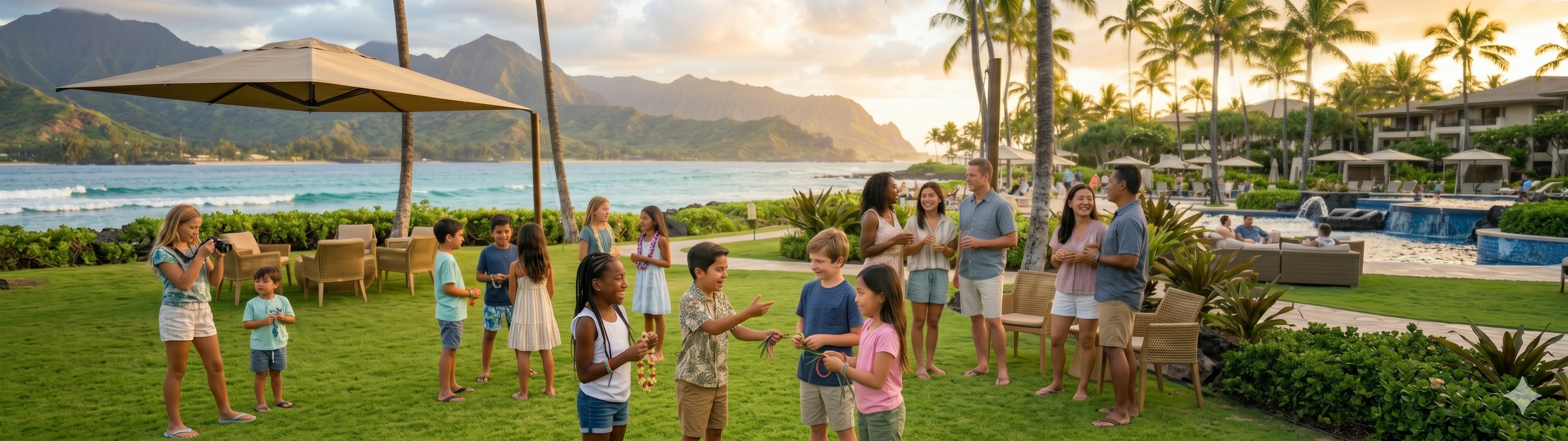
Once per year, the entire Finest School student and parent community convenes in Hawaii. Not optional enrichment — a structural element of the community architecture: the moment when the global peer cohort that has been connecting across academic years meets in person.
Regional student and parent communities operate continuously at each hub. Standing communities — meeting regularly, with the school and SPC providing the framework and facilitation.
| Established by | Global Lifestyle OS + US elite private school partner(s) — jointly. Equal governance authority. |
| Decision scope | All decisions on school establishment, operational standards, curriculum, staffing, regional expansion, and IP governance. Neither party can act unilaterally. |
| Intellectual property | New IP generated vests in the SPC. US partner school IP is licensed to the SPC. GLO-developed platform IP remains with GLO. |
| Asset structure | All school-related assets held within the SPC. Ensures long-term institutional independence and protection of partner schools’ reputational investment in this framework. |
| Quality governance | Formal semester review of educational outcomes and platform performance. Standing improvement committee meets quarterly. Continuous evaluation — not periodic audits. |
| Cost model | Each programme component independently priced by the SPC. Families subscribe by choice. Mandatory elements comply with applicable US and local law. |
| Strategic partner | A strategic business partner joining Global Lifestyle OS gains full access to the SPC structure and its compounding value. The school framework, the 26-year network, and the SPC governance come as one integrated platform. |
| Formal signing target | Partnership agreement with lead US partner school(s): H1 2027 |
For 26 years, I watched clients cancel travel plans because of their children’s schooling, and watched families separate because no school could follow them. The framework we have agreed makes that problem structurally impossible — not managed, eliminated. The same institutions that the world’s most discerning families have trusted for generations are now part of the architecture that travels with those families.
The SPC, the 26-year school network, and the platform infrastructure are developed and held by Global Lifestyle OS. A strategic business partner who joins GLO gains full access to this framework and its compounding institutional value. These assets do not exist as separable components — they are one integrated platform, and they move together.