Global Lifestyle OS · The Finest School · Intelligence Brief · June 2026
The Strategic Logic Behind
Elite Private School Partnership
The Most Valuable Testbed in the World — and Why Only This Platform Can Access It
Artificial intelligence finds its fastest commercial path not through factories or roads, but through the one environment with the lowest risk, the most structured data, and a client base actively demanding it. The challenge is accessing that environment without triggering the institutional resistance that is stopping every other platform. This document explains how.
Physical AI Testbed
26-Year School Network
AI Without the War
India · INDUS-MATRIX
Partner Elevation Model
First-Mover · Irreplicable
Chapter 1
The Most Valuable
Physical AI Testbed in the World
Physical AI — intelligence embedded in machines that perceive, reason, and act in the real world — faces one fundamental challenge before every other: the environment it must operate in. A factory has thousands of variables. A public road has millions. The classroom has neither. And yet no platform has claimed it.
The Physical AI market was valued at $81.4 billion in 2025 and is projected to reach $1.145 trillion by 2035. Manufacturing and logistics dominate current deployment — but they also carry the highest regulatory friction and the longest path to commercial scale.
Source: Kaiso Research, Global Physical AI Market Report, May 2026
Education offers the opposite profile: low regulatory friction, structured data, a human-interaction environment that is the product rather than the hazard, and a client base that is actively demanding the technology.
Why Education Deploys Faster Than Any Other Physical AI Environment
| Dimension | Factory / Road Deployment | Education Deployment |
|---|
| Environment | High variance, unpredictable, physically dangerous | Controlled, low variance, physically safe |
| Regulatory path | Aviation, automotive, industrial safety — multi-year approval cycles | No equivalent barrier; pilots can begin immediately |
| Data structure | Unstructured sensor data across infinite physical scenarios | Standardised curriculum — AI already trained on this data |
| Human interaction | Incidental — machines avoiding humans | Core — human interaction is the product |
| Failure consequence | Physical injury, liability, reputational damage | Suboptimal session — recoverable and measurable |
Every hour a physical AI platform operates in an educational environment accumulates what is hardest to generate anywhere else: rich Human-Robot Interaction data in an unstructured emotional and cognitive context. A child expressing frustration, losing focus, or making a conceptual breakthrough — each of these creates training signal that directly informs physical AI performance in homes, hospitals, and workplaces.
"The education deployment is not a separate business. It is the R&D infrastructure for every subsequent physical AI application."
The Market Scale
Global AI in Education
$57B
Projected market by 2033. CAGR 25.9%–34.52% depending on segment.
EdTech Global
$785B
Projected total EdTech market by 2035. SNS Insider, June 2026.
AI K-12 Education
38%
CAGR 2026–2036. Market reaches $18.47B by 2036. Future Market Insights.
Humanoid robots are already deployed in classrooms across 40+ countries as teaching assistants, peer tutors, and special education support tools. The infrastructure is not theoretical — it is being built now, with or without a coordinating platform.
Source: Robozaps, Humanoid Robots in Education, June 2026 · Frontiers in Education, February 2025
Chapter 2
The Wall That Is
Stopping Everyone Else
If the opportunity is this clear — and the data confirms it is — why has no competitor built this platform? Because there is a wall in the way. And it is not a technology wall.
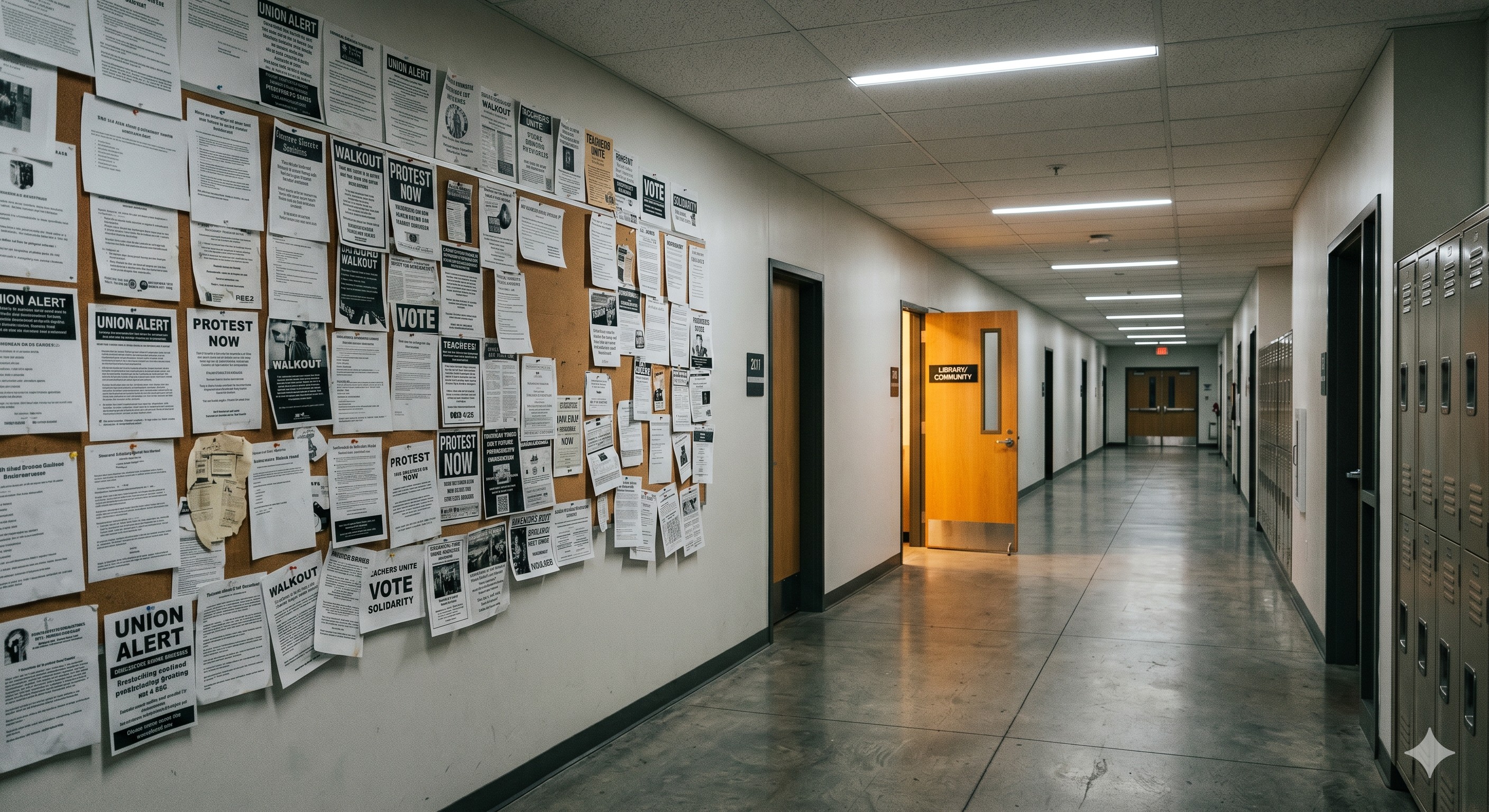
Institutional Resistance — Documented, Organised, and Politically Potent
The American Federation of Teachers, representing 1.8 million members, released a formal 10-point plan in May 2026 calling for wide-scale rollbacks of student AI use and restrictions on AI tools in classrooms. This followed a complete reversal from the year prior, when the union had sought a "seat at the table" with technology companies.
Source: Education Week, May 27, 2026 · NBC News, May 2026
The UK's National Education Union, in a survey of 10,311 teachers conducted in February 2026, found that 49% opposed AI deployment plans in their schools — and 66% reported no school policy existed for student AI use, unchanged from 2025.
Source: National Education Union, State of Education: AI, April 2026
At the international level, the Education International global federation issued a formal declaration: "Human First. Always. Teachers Lead. Technology Serves." — framing AI deployment as a direct threat to professional autonomy and job security.
Source: Education International, Trust Cannot Be Automated, January 2026
Why the Resistance Is Structural — Not Attitudinal
This is not a communication problem. The resistance is rooted in five mechanisms that reinforce each other and cannot be resolved through messaging alone:
| Resistance Mechanism | What It Protects | Why It Persists |
|---|
| Knowledge scarcity | Teacher authority derives from being the sole knowledge source | AI removes the scarcity; resistance preserves the authority |
| Status erosion | From 'respected educator' to 'machine supervisor' | Social status is non-negotiable; no efficiency argument overrides it |
| Collective defence | Union scale = political leverage | 'Children first' is the public justification; job count maintenance is the mechanism |
| Incumbent advantage | Decades of promotion structures optimised for human evaluation | AI-based performance metrics expose everything the existing framework conceals |
| Change fatigue | Existing workload already at capacity | New competency requirements feel like punishment for doing the current job |
"The fastest-available Physical AI deployment environment is simultaneously the most institutionally blocked. The market with the lowest technical risk has the highest human resistance."
This is the structural contradiction no conventional platform can resolve — because any organisation deploying AI into existing school systems must negotiate with, compensate, or override this resistance at every step. Every dollar spent fighting this wall is a dollar not building the platform.
Chapter 3
Why Elite Private Schools
Are Different
The institutional resistance described above is a feature of public school systems and large conventional operators. It is not a feature of elite private schools serving a mobile, globally-oriented client base. This distinction is the structural opening that makes this platform viable where no other approach can be.
A Governance Structure That Changes Everything
US elite private schools are not governed by elected boards, subject to union agreements, or constrained by public procurement rules. Their governance is controlled by boards of trustees, their faculty is employed at the administration's discretion, and their curriculum is designed entirely internally. Technology adoption moves at the pace the administration sets — with no union veto.
In 2026, these schools are actively partnering with technology companies — integrating AI, robotics, and digital platforms far faster than any public school system can move.
Source: PrivateSchoolReview.com, How Elite Private Schools Partner With Tech Companies, 2026
Their clients — families paying $60,000–$90,000 per year in tuition — expect it. The technology adoption timeline of a public school district is not acceptable to a family at this level. They expect their children to be educated with the most advanced tools available. And they will move to the institution that provides them.
What These Schools Cannot Build Alone
Elite private schools hold extraordinary assets: curriculum authority, accreditation, university admission pathways, global reputation, and deep alumni networks. What they cannot build, regardless of resources:
| Capability | Why They Cannot Build It |
|---|
| Location independence | Their model is built around a campus. The client is globally mobile. The campus cannot move. |
| AI-native curriculum delivery | Requires technology infrastructure and ongoing AI investment outside any school's core competence |
| Globally mobile family retention | A student who relocates loses their place. No mechanism exists to serve families across multiple cities simultaneously. |
| Physical AI integration | Humanoid educational robots require hardware, software integration, and operational management no school is built to handle |
| Cross-location learning continuity | Real-time synchronisation across FBO hubs, residences, and transit — technically and operationally outside any school's capability |
These schools understand this gap. They are watching their highest-value families leave — not to competing schools, but to mobility patterns that a fixed campus cannot accommodate. The family relocating from New York to Singapore to Dubai is not served by any school, however excellent, that is anchored to one address.
"A family relocating from New York to Singapore to Dubai is not served by any school — however excellent — anchored to a single address."

Chapter 4
Why They Welcome
This Partnership
The platform does not approach elite private schools as a competitor or a disruptor. It approaches them as the infrastructure layer their model needs to extend beyond what a campus can serve. The result is genuinely additive — not a negotiation in which one party loses.
What the School Gains — In Each Faculty Member's Terms
Elite private school faculty do not share the union-driven resistance of public school teachers. But they share the underlying concern: professional dignity, career trajectory, and the value of their expertise. The platform resolves each concern directly:
| Faculty Concern | What the Partnership Provides |
|---|
| "Will AI replace my role?" | AI handles knowledge delivery. The teacher is elevated to curriculum designer, mentor, and academic strategist — roles that require human judgment no AI system replicates. |
| "Will my salary decrease?" | Teachers deployed to client locations earn premium compensation. A designated visiting teacher commands rates no fixed-campus position approaches. |
| "Will my expertise matter less?" | The 26-year network provides curriculum authority and accreditation that AI cannot manufacture. Teacher expertise becomes the quality signal clients pay for — it appreciates, not depreciates. |
| "Will I lose professional identity?" | The teacher becomes the human face of a world-class institution operating at global scale. Their identity expands from 'teacher at one school' to 'designated educator, internationally deployed.' |
| "Who will I be teaching?" | The children of UHNWI families and Fortune 1000 executives — the most engaged, highest-value educational relationships available anywhere in the world. |
What the School Gains — At the Institutional Level
| Institutional Gain | Mechanism |
|---|
| Revenue beyond campus capacity | Subscription-based service to globally mobile families. No physical seat constraint. Revenue is not bounded by classroom count. |
| Retention of the mobile family | A family that would otherwise leave the school's orbit due to relocation remains enrolled. Tuition continues. Alumni relationship deepens. |
| Global reputation extension | The school's curriculum travels to Singapore, Dubai, Geneva, and Honolulu. Every family served is a demonstration of the school's global reach. |
| AI leadership positioning | The school is positioned as the pioneer of AI-native elite education — the institution that solved the problem every other school is still debating. |
| Physical AI testbed access | First-mover access to the most advanced educational technology deployment in the world, generating data that informs curriculum design for generations. |
| New talent pipeline | The visiting teacher model creates a high-value international deployment track that attracts the most ambitious, globally-oriented educators. |
The Structural Logic — Why This Is Irreplicable
Any competitor who wishes to replicate this partnership model faces one insoluble problem: the relationships required to establish it were built over 26 years. They cannot be purchased. They cannot be accelerated. The trust that makes a US elite private school willing to extend its curriculum authority, its accreditation, and its name to an AI-native mobile platform is not a negotiable asset — it is the product of two and a half decades of demonstrated competence and shared educational philosophy.
"A well-capitalised competitor can acquire technology in six months. They cannot compress 26 years of trust into any shorter timeframe. This is the one competitive barrier in this business that capital cannot overcome."

Chapter 5
India —
Where the Logic Amplifies
Every argument in this document becomes more powerful in India. The country represents the single most compelling convergence of Physical AI opportunity, education demand, and wealth migration dynamics in the world today.
The Market Data
| Metric | Figure | Source |
|---|
| India school market | $54.2B (2024) → $135.6B (2033) | IMARC Group 2025 |
| India AI in Education | $270M (2025) → $1.975B (2032), CAGR 32.85% | BlueWeave Consulting 2026 |
| India UHNWI growth | 12,069 → 19,119 by 2027 (+58.4%) | Knight Frank |
| India HNI growth | 797,000 → 1,657,000 by 2027 (×2) | Knight Frank |
| India IB schools growth | 107 (2013) → 240+ (2024): +124% | ISC Research |
| Indian families' intl education spend | $3.71B in 2025, up 31% from 2018 | Henley Education Report 2026 |
| India government AI-in-education | ₹100 crore allocated, 2026–27 budget | Union Budget 2026–27 |
| India edtech projection | $29–30B by 2030 | IBEF 2026 |
India introduced AI curriculum across all schools by 2026 under its National Education Policy framework — signalling top-down institutional support for exactly the technology this platform delivers.
Source: Ernst & Young-Parthenon Report, September 2025
The Cultural Amplifier
India is not simply a large education market. It is a market where education is treated as the primary investment in a child's future — not a cost, but a cultural imperative.
- 90% of affluent Indian parents fund overseas education fully — up to 64% of retirement savings committed (HSBC 2024)
- India ranked the world's 2nd largest international school hub in 2025
- Indian families' international education spending up 31% from 2018 to 2025
- India's UHNWI population projected to grow 58.4% by 2027 — the fastest rate of any major economy
This is a population that is simultaneously wealthy, technologically sophisticated, education-obsessed, and globally mobile. The most precisely aligned client base for a platform combining AI education with private aviation and global mobility infrastructure.
The Compounding India Logic
- IT and AI literacy is higher among India's elite than almost any comparable demographic globally
- Physical AI deployment finds a technically receptive, regulation-light environment with massive scale
- Education spending as share of household wealth is unmatched — the platform's pricing model meets zero resistance
- The global mobility thesis amplifies: India is simultaneously the world's largest wealth migration source and one of its fastest-growing UHNWI populations
Chapter 6
The Position That
Cannot Be Replicated
The arguments in this document converge on a single conclusion. Four structural advantages intersect here that no competitor — however well-capitalised, however technically capable — can replicate by assembling resources alone.
What Capital Can Buy
- Technology infrastructure — in 6 months
- Faculty and staff — in 6 months
- FBO locations — with enough capital
- AI curriculum design — with the right team
- Market entry into India — with investment
What Capital Cannot Buy
- 26 years of US elite school trust — requires 26 years
- AI deployment without labour conflict — requires original design
- Physical AI education testbed — requires the school relationships
- UHNWI client relationships at this depth — requires field time
The Four Advantages That Compound
| Structural Advantage | Why It Cannot Be Replicated |
|---|
| 26-year elite school network | Time is the only currency that builds trust at this level. Capital compresses time in every other domain. Here, it cannot. |
| AI deployment without labour conflict | Requires designing the partnership model from inception — not retrofitting it onto an existing structure. Competitors have existing structures. |
| Physical AI education testbed | First-mover in the highest-quality, lowest-friction AI deployment environment available — with data rights and institutional relationships locked in. |
| India + global mobility convergence | Requires simultaneous depth in education, mobility, and ultra-high-net-worth client relationships. No competitor holds all three. |
The Physical AI market will exceed $1 trillion by 2035. The AI education market will reach $57–137 billion in the same period. India's UHNWI population will grow 58% by 2027. Global wealth migration is at an all-time high.
Every one of these trajectories is confirmed by independent market data. Every one of them points toward the same infrastructure gap. The question is not whether this market exists.
"The question is who captures it — and whether the window to participate in that capture is still open."